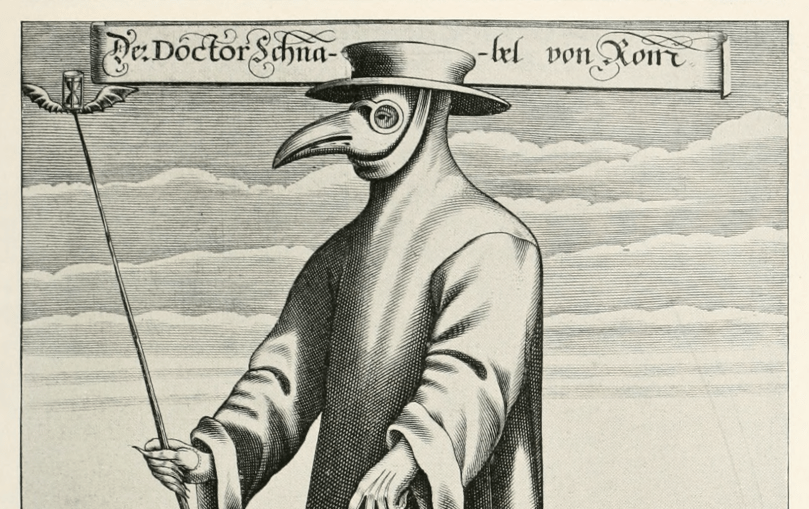
I went to the beach yesterday afternoon—not the way I normally start posts on this blog—and while I was there, I did some thinking and subsequent writing in my notebook about world building. The first topic was diseases and plagues as conflicts in fantasy RPG settings like D&D, and how magical healing might change the nature of people’s relationships with them. Next, I considered how churches to evil deities might exist.
So the following words are copied verbatim from my notebook, except for the third paragraph in the first section, a thought that came to me as I was typing and considered a little more this problem.
On diseases in a world with magic
Natural diseases (and unnatural) are a real and potentially devastating threat to the urban citizenry. For the adventurer with magical resources or the wealthy lord with the ability to purchase magical healing, such as with lesser and greater restoration, these are merely inconveniences. There is little incentive, directly, for the powerful to do anything about diseases and the conditions that cause them, because they are not threatened, as they would be in a world without magic or modern medicine.
Outbreaks of diseases would also be very profitable for magic healers. Clerics could gain many followers for their religion in exchange for the healing they provide, and plenty of remuneration from the wealthy in exchange for healing and protection both. It is conceivable that less scrupulous religious orders might celebrate or even manufacture an outbreak.
Added later: Healing magics do, of course, have material components. On the scale of a single adventuring party, the costs of these components are abstracted and forgotten, but on the scale of a city or kingdom afflicted by an epidemic, these material components could start to become very scarce.
On the worship of evil deities
There are evil deities that have followers and worshippers who are allowed to operate in cities with impunity, if not always entirely openly. Yet no one is likely to knowingly and willingly serve evil unless they are pursuing their own ends, with the evil deity’s boons as their means.
It seems then that, beyond the rare fanatics who worship evil out of some sort of madness, there are two reasons one might worship evil deities: fear and power.
The fearful pay tribute in order to keep the deity’s wrath away, mostly from themselves. This is the case with Umberlee, whom seafarers pay tribute to before their voyages in the hope that she will spare them. One might likewise try to bribe gods of death to direct their gaze and perform their collections elsewhere. This line of reasoning presumes of course that deities do act directly upon the material plane, or else are believed to do so.
Others worship for power, because the things they want or need require the committing of some sins, or are at least more easily achieved that way. These are the worshippers whose activities must be more clandestine. It is difficult to justify trying to harness the favor and power granted by a god of death, because his means are of course mostly malicious in nature. These are your “cultists,” and they are perhaps more dangerous but also more easily condemned. They are after personal gain, while the fearful tributaries are trying only to survive.
 No Free Parking Money
Here’s how to make diseases interesting: there’s a plague/outbreak of a disease whose combination of lethality and infection outpace the ability of healers–magical and mundane–to control. (Consider ghoul fever, as an interesting possibility here–like a zombie outbreak but with intelligent, disease-spreading monsters instead.) The PCs won’t have a direct problem from/with the disease, however the rest of society in the city/state/country/world will have a problem. Thus, the disease becomes an interesting back drop to the story.
Yes, that was sort of my unspoken conclusion, that it would be a big problem still for the world, though never for the PCs, and rarely for the wealthy in general. And I would guess that most outbreaks of disease would outpace the abilities of the magical healers to treat them, unless it’s a magic-heavy world, since it requires relatively powerful magic, at least in D&D.
Another option might be to have a divine disease sent by an evil god of magic to punish mortals for over-use of magic. Perhaps the disease simply cannot be removed by “remove disease,” or perhaps the “disease” is technically a communicable curse that requires “remove curse” instead (this is likely the better route so as to not seem so heavy-handed to PCs with “remove disease”).