
As you might guess from the title, this post is about a couple of different ways in which a PC in D&D might fall a great distance and not care too much about it. In some cases, it’s just luck; but sometimes it’s an inescapable part of the system.
The Fluke
Last night at D&D one of my gargoyles got a little lucky and managed to push the paladin off a bridge, causing said paladin to fall 50 feet. I was pretty excited by this, because I don’t usually push players off of things, and the odds were against the gargoyle succeeding in pushing him off anyway.
And then this happened.
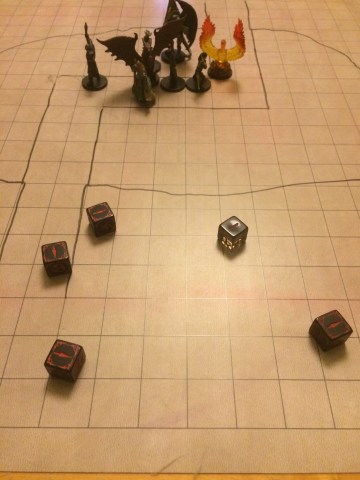
Roll 5d6 falling damage (1d6 per 10 feet), and get all 1’s. Ugh. What a disappointment.
I’m not actually upset about this. It’s never (specifically) my goal to kill a player, even though I can’t help but get a little excited when the prospect comes up. Mostly I just find this very amusing with an ample helping of absurdity. Seriously, how do you even picture a paladin falling 50 feet and only taking five damage?
The Unrelated and More Important Problem
This encounter reminded me again of a larger issue, which is that falling has always disappointed me, especially anywhere above, say, level 3. When a level 1 character falls 20 feet, with 2d6 damage, there’s a chance that the character has fallen unconscious. Fall 50 feet, and it’s not unlikely that they’re outright dead. But when a level 10 character falls either of these distances, the damage is trivial, because 10d6 damage isn’t going to kill anybody.
I really like falling as a hazard. I like evoking the fear of heights, of players thinking twice before marching out onto a bridge suspended 50 feet in the air, or getting worried when a pit trap opens up beneath them and drops them three stories into a dungeon cell. There’s a feeling of helplessness from falling, and that helplessness comes from the contemplation that at the end of this fall, there is inevitable pain, and you just have to wait to see how badly it’s going to hurt.
Gravity is a great equalizer, and no matter how skilled you are in combat or at “shrugging off” blows, physics is physics, and PCs should all be subject to its consequences at any level.
I want my level 11 PCs to fear a drop as much as my level 4 PCs, without having to scale the heights to ludicrous extremes. That 50 foot drop from the bridge, in order to be proportionately dangerous to level 11 characters, would have to be over 130 feet. And when you get to heights like that, I don’t see how you can imagine that being anything other than lethal without some magical or divine intervention.
Many people I’ve spoken to (and whose thoughts I have read online) have suggested increasing the damage of falling, the best idea being changing it to a cumulative 1d6 per 10 feet, making a quadratic progression: 10 feet is 1d6, 20 feet is 3d6, 30 feet is 6d6, 40 feet is 10d6, etc. It’s compelling, and not a terrible idea on the whole, but it doesn’t quite address my central problem. An ideal solution would mean that a sleeping PC who falls 50 feet contemplates their mortality at level 15 as much as they do at level 3.
This may be the only point in D&D where the lack of verisimilitude really bothers me, because it affects the way I design my environments and hazards, and it flies so strongly in the face of my sense of the world that it actually makes it hard for me to maintain my own immersion when someone falls several stories without breaking a sweat just because they have more hit points, whatever those are.
In most other areas, hit point abstraction doesn’t bother me. A fighter at level 15 is less worried than a wizard at level 3 about a hill giant’s greatclub, but that’s because a “hit” doesn’t necessarily mean, in the fictional narrative, that the greatclub made contact and hit its target square. Hit points are meant to be an abstraction of wounds, some level of fatigue, luck, some kind of will to live perhaps, and whatever else you want to throw in there; I’m okay with that. But I just have a great deal of ignoring this into abstraction.
Possible Solutions
So I need a solution. And, to conclude, here are some ideas:
- Increase damage from falling to a cumulative 1d6 per 10 feet (as above). Higher level characters can fall farther without dying, but only within reason, because 60 feet would already be 21d6 (average 73.5) damage.
- Scale damage by the player level. How exactly this would work, I’m not sure yet, perhaps because I haven’t yet decided the acceptance criteria for falling. My gut tells me that players might not like that this mechanic feels like it punishes them for being a higher level, particularly when you consider the resources required to heal someone from the fall.
- Include consequences besides damage. Again, I’m not sure what this would look like. Perhaps the player makes a save (Strength or Dexterity, possibly their choice), and depending on their save, they incur some other penalty, which could include dying as the most severe penalty. This could also meet the unconscious faller criteria, since unconscious creatures automatically fail Strength and Dexterity saving throws.
- Freeform falling damage. How much damage does a 50 foot fall cause? As much as is dramatically appropriate. In other words, forget consistency and just go for what would be most fun and maybe also passes the verisimilitude gut check.
I’m not sure what would be best. Your ideas are solicited. So how would you solve this? Or not; maybe you like the idea that the hero they write songs about really can fall ten stories, shake the dust off, and walk away?
 No Free Parking Money
Good post, Mr. Gibbs. I think anyone who’s played this game long enough can identify with your frustration.
To cut to the chase, I’ll share my idea (spurred by your post). I’ll start with the observation that the difference between a saving throw and an ability check can guide us here. Somewhere in the back of my memory of learning the D20 system is a rulebook comment that something is best done as a saving throw if a character of higher level should be better at it, but that that same something should be done as an ability check if a character of higher level would be no better at that thing than a lower-level character. I believe the book provides the example of holding your breath as an example of this ( a constitution-related task, not a fortitude-related task).
Just as hit points are largely level-dependent (as are saving throws), I would argue that a character’s ability scores are *not* (barring occasional, mild increases from character advancement and magic items. Thus, my proposal would be to cut right to the chase with falling damage.
Were falling damage to cause ability damage (constitution, dexterity, and/or strength), then it would largely avoid the realism-breaking issues that your post raises. Perhaps 1d6 ability score damage per 10ft. of fall (ignoring 10 feet for a purposeful fall, and perhaps another 10 or more feet with a successful acrobatics check of varying difficulty) is a way to keep falling scary to players of all levels.
One might roll a d3 to see which physical ability score is going to take the damage, and then roll the relevant d6s. Or perhaps constitution and either strength or dexterity? The devil is in the details here, although such a system would have the benefit of scaling well with levels.
To the extent that higher-level characters have higher ability scores due to magic items and perhaps spell effects, that is fine. I’m personally OK with magic breaking realism in a fantasy roleplaying game–it’s somewhat the point.