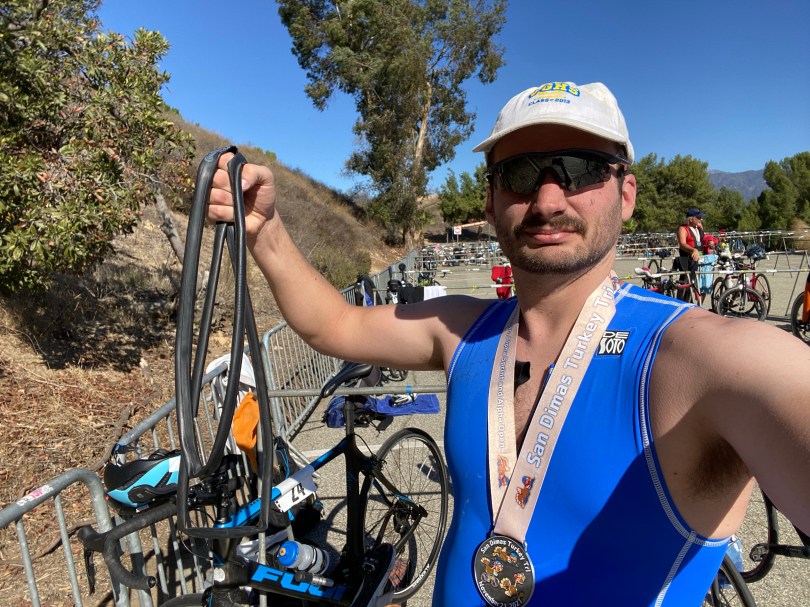
A few weeks back on the Sunday before Thanksgiving, I did my first triathlon in over two years, my first since I broke both of my wrists in September 2019, my first since the pandemic descended, my first since the birth of my son, Graham, who turned a year old in October. Appropriately, and mostly by design, my first race back was a return to my first ever triathlon, the Turkey Tri in San Dimas.
The Turkey Tri was always in my regular rotation of races every fall. It was always a very relaxed atmosphere with lots of supporters coming to cheer on their friends and family in the event, like small children holding signs for their mom or dad. It only ever offered a sprint distance, which was fine because it forced me to treat it a bit more like a celebration of my triathlon season than as a tough race to target and train for. But this year was entirely different, and this was easily one of the toughest races I’ve ever done.
New Management, New Tri
Since the last event was held in 2019—which I didn’t compete in due to aforementioned bilateral distal radius fracture—the Turkey Tri was acquired by a new racing organizer, Alpha, who added an Olympic distance to the event. That was exciting news to me, since I usually like doing Olympic distances more than sprints. But the course also changed, which, to be fair, may not have been a decision made by Alpha.
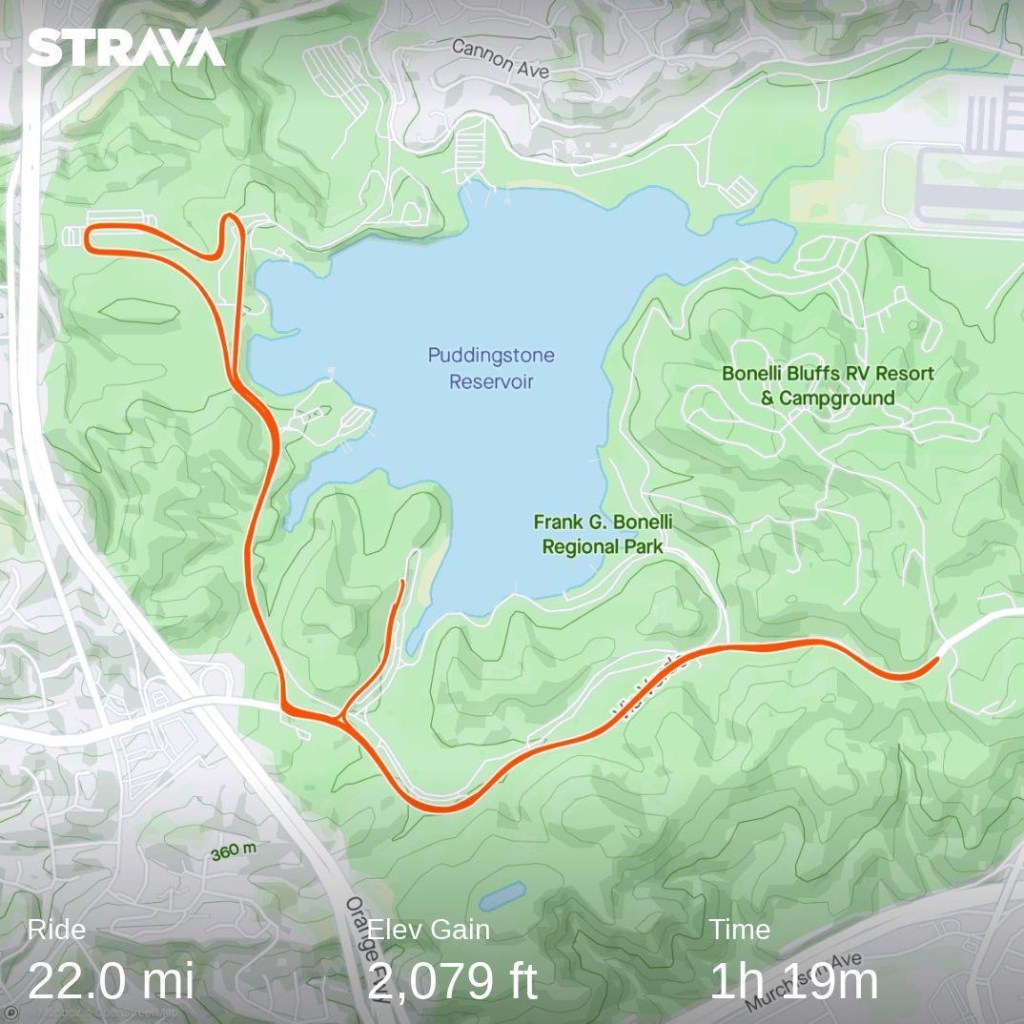
The new course cut out the back half of the ride that wrapped around the nearby airfield, turning the loop into a bull’s horns double out-and-back route. That airfield and the roads around it sit at bit of a higher elevation than Bonelli Park, which means that the old course included a hill climb on the first half of the loop and a descent on the second half as you came back toward the lake and transition area. The new course kept the hills but lost the flats around the airfield, which meant each horn on the bull was a hill climb to the turnaround and a descent on the way back—twice the hill climbing of the old course. This course had more than twice the ascent of the Malibu Triathlon, which rides along Pacific Coast Highway and isn’t designed in any way to be a flat course, by a fair margin. But what really drove it home was how dicey the downhills were.
On the first horn—which wasn’t a perfect out-and-back, with the return taking roads that are more or less parallel and adjacent to the way out to the turnaround before re-merging—the downhills were full of turns and debris, so I couldn’t get up to speed without risking a crash from losing control of my bike. On the latter horn, the race only occupied one side of the road, while vehicular traffic used the other. Under ideal circumstances, there certainly is room for this, since it is a wide road, but while cones silently requested that drivers not hit the cyclists, there were no markings dividing the riders in the race going uphill and those in the race going downhill after hitting the turnaround. This meant that as I was riding downhill—and it was a significant downhill, one that in previous years I once enjoyed tucking and getting as much speed on as possible—I was wary of the cars on my right as well as the riders weaving uneasily uphill toward me on my left. I scarcely let go of my brakes the entire time.
It’s too bad that the bike course was such a challenge, because it must be very discouraging to any less experienced triathletes, the kind that come with their families holding “GO DAD GO” signs and sticking around for pie afterward while the spouse politely listens to the athlete talk to them and other participants about how the race went. But that wasn’t the only transgression.
The other transgression was the running course support. In my first mile or so of the run, at a certain point I questioned whether I had taken a wrong turn somewhere, because within sight of me there were no other participants, no course markers, and no volunteers. When I did eventually see a volunteer, who was monitoring the nearby bike course, I had to ask him if I was going the right way. (I was.) The distance between aid stations felt similarly vast, and more than once I ran to an incidental water fountain just off the route to take a sip. Such a minor detour is fine so long as no one else is doing the same thing at the same water fountain, which did happen to me once.
One quick note about the swim is that it was a water start, so we were all already about waist deep in the lake at the starting line. They said this was for safety, I guess in consideration of a combination of the number of people scrambling together at the same time and the lake bottom being a bit treacherous.
Overall, it simply felt like there was less support for the race this year: fewer volunteers; fewer route markers; fewer spectators; and less road space given over to the event.
It Finally Happened
The last obstacle had (probably) little or nothing to do with the setup of the race, and everything to do with luck finally catching up to me: my first flat tire in a race.
I was on my second lap of the double out-and-back out of a total of four laps, just starting to climb the second horn toward the turnaround, when I heard: tsst!—tsst!—tsst! It was my tire letting out air through a puncture each time it rotated. Ever since my first triathlon at the Turkey Tri in 2014, I knew that someday I would get a flat during a race if I did enough triathlons. It was something that I had been mentally and logistically preparing for, so when it happened, I didn’t panic; I just pulled over and changed my tire as fast as I could.
It may not have been entirely bad luck though, because on my first lap I had seen multiple riders in the same predicament as the one I then found myself in. Maybe the roads were especially rough or covered in too much debris. Seeing this did provide just a little bit more of a sense of readiness when it happened to me, because already I had imagined myself being one of the riders I saw stuck on the side of the road, changing a tire.
But while I was ready—I had all the equipment I needed and I had changed inner tubes plenty of times while out on workouts or commutes—I did not have a great deal of expertise at it. It took me about fifteen minutes to change my tire, according to my race log taken by my Garmin watch. That time wouldn’t have been so notable to me except that I was less than nine minutes back from the first place finish in my age group, so theoretically, without the flat, I could have had an age group first place finish for the first time in my triathlon experience. Or maybe not, because I also wouldn’t have had those fifteen minutes of recovery from the first few hill climbs.
Something New On Race Day
The last notable piece was entirely an unforced error on my part. I decided to clip my shoes to the pedals before the race and to run barefoot through the transition area until it was time to mount my bike. I had done it successfully before, but it had been, again, over two years, and I hadn’t practiced it since then. I messed up a couple parts of it, and the resulting effort was enough of a failure that I probably added more time to my bike section than I shaved from my transition.
In an Olympic distance race, the few seconds gained or lost by such a stunt are less likely to make the difference for, say, a podium finish or a personal record for a course. Since this was a new course, and since I got a flat during the bike anyway, this really was trivial in terms of my time and it’s impact was mostly psychological.
Conclusions
The quantified results almost aren’t even that important to me, since this race was in so many ways anomalous, but here are the age group results and the Strava records (swim, T1, bike, T2, run, but I think you need a Strava account to view these). I didn’t even check the standings before I left the event—probably the first time I’ve done that—because I figured there was no way I was even close to a competitive time after changing my flat and after two years of not racing and after not having nearly as much time to train now that I’m a parent. But to my surprise when I finally looked from home, I got third place in my age group. It’s not a big age group, only seven people overall, but still, I beat the median even with my mid-race disaster. I guess that feels good.
There were only 55 finishers altogether, which I think is considerably smaller than the event has been in past years, though granted this year the participants were split across two different distances. I suspect that overall registration was also down though. My age group, even though it was only seven people, was still the largest age group, and most of the female age groups were either vacant or only had one finisher.
I don’t know that I’ll do this race again next year. Probably I won’t. The biggest reason not to is how sloppy the bike course was. The hills were a lot, but I could accept that on its own as the course being hard but not bad. The real trouble was the rough and winding roads in the first horn of the ride and the poor course management on the second.
The shame of not doing this race again next year, beside in this case the loss of something of a tradition for myself (even though due to injuries and the pandemic I actually hadn’t done this race since 2017), is that I can’t use this year’s time as a new baseline to beat. That target of year over year self-improvement has always been a big motivator for me as a triathlete. Because I had no baseline going into the event this year, and being so out of practice, my only goal was not to walk in the running section, which I managed to do (minus short slowdowns for water). I’ll satisfy myself knowing that, despite everything, I accomplished that goal and can still competitively complete an Olympic distance triathlon.
 No Free Parking Money
Congrats on getting back at it, on not walking, and on changing your tire during the race (which sounds intimidating to me). 🙂