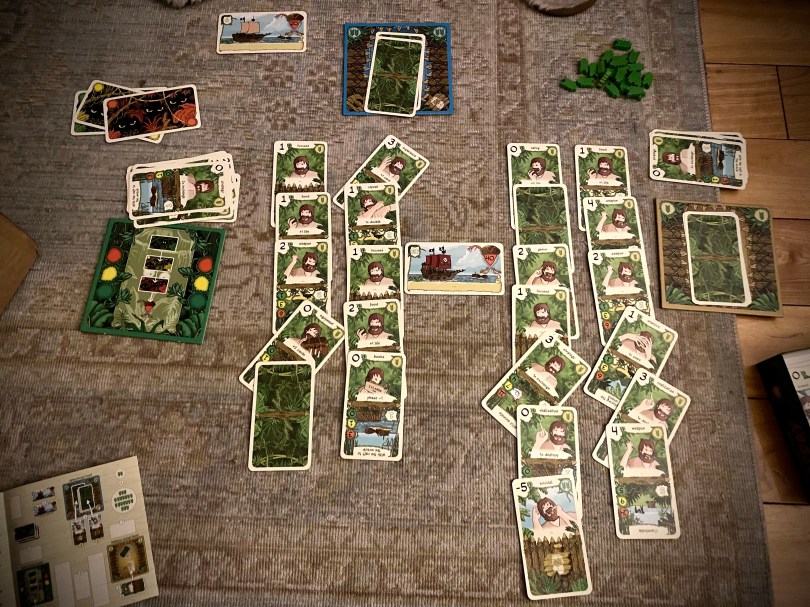
My good friends Ben and Lizzy got me a copy of a game called Friday for my birthday recently. I think it’s my first single player tabletop game aside from the various forms of solitaire you can play with a poker deck. This is a deck building game themed off of Robinson Crusoe, with you as the player trying to toughen up Robinson before he gets himself killed. I’ve played it five times now, and I’ve lost every single time. But I’ve played enough to have some thoughts on the game.
By way of further basic introduction, the game is called “Friday,” authored by Friedman Friese (get it?) and published by Rio Grande Games. So now you can find it if you like. The box says it plays in 25 minutes, but I think my games are a little shorter, probably because I keep losing. Or maybe I’m losing because I’m rushing. Maybe both.
First, this game wasn’t as easy as I thought. I expected to lose once or twice at first, especially considering I was playing on “Level 1,” the easiest level in the rules. I figured the first level would be a kind of tutorial, after which I could pick my try the “real game” and start honing my strategies. I was quite wrong.
Each game progresses through three increasingly difficult phases, plus the endgame battles against the pirates. Only in two of my games did I make it to the pirates, and in one of them I didn’t actually have time to play through it—so I guess technically it’s like four losses and a TKO—and in the others I lost in variously helpless fashions.
But it’s nice to know I have some considerable headroom for this game, since I do not have any opponents whom I can expect to also grow increasingly sophisticated in their strategies.
Second, I do need to make a note about the rules, which are not terrifically clearly written. It’s possible I’m misreading something somewhere that would tilt the scales in my favor. And it’s not that the rules are overly complex, but that the wording is poor. Lines like, “For the life points you pay in this manner you can destroy face up fighting cards and remove them from the game. You spend one life point to destroy one of the Robinson or knowledge cards and two life points to destroy an aging card.” It’s not clear whether it’s:
- You may remove cards from the game whose total destroy cost is up to the number of life points paid. Aging cards have a destroy cost of two, and other have a destroy cost of one.
- For each life point paid, you may spend an additional life point toward destroying a card, according to its destroy cost.
- Instead of paying life points, you may pay with the destroy costs of cards played.
I’m assuming and playing as if it’s the first option, which is most mechanically interesting, and seems to be what they’re trying to say. Maybe. Probably.
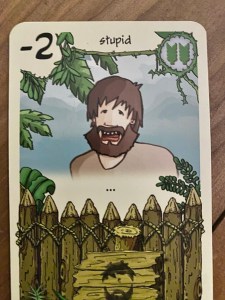
Third, and maybe biggest, is that this game really has me thinking about the equivalence relationships of resources in the game. You can spend a life point to draw an extra card, so a life point is in some ways equivalent to a card draw, but also each card you draw gets you closer to adding an aging card, and the aging cards get much worse once you’ve added a certain amount of them, so you don’t want too many of those. And there’s a tradeoff in keeping your deck pruned of underperforming cards—by the third phase, you need an average card strength of almost three points per card—and keeping your deck beefy enough to keep from having to add an aging card when your deck runs out.
I’m sort of deliberately not explaining the rules because I’m sure there’s a YouTube video telling you how to play if you like.
The average strength of your cards is more complicated than summing and dividing, because many cards have special actions that can boost your overall score in a round, say by doubling your highest value card or allowing you to draw more cards.
It seems that I need to discover (apparently the hard way) how to balance the size of my deck, the strength of my cards, the progression toward the endgame, and my life points to maximize my odds of success. I think there’s probably some magic numbers I should be targeting, like an average card strength of one, two, three, and four for each game phase plus the endgame with the pirates. And I could do a better job keeping track of what’s in my deck to get an idea of where I am on the card strength track, including how many underperforming cards I have, how many I have in total, and what special abilities I have built up.
This could be a long road. I’ll let you know if I start winning.
 No Free Parking Money
I’m invested in this saga.