I’m in Chicago this week visiting my wife’s sister and her family, which includes a three-year-old and a one-month-old. The latter won’t get too much attention on this post; she’s still working on turning over from her belly to her back. But the older kid has lots of toys, puzzles, and games, of very different varieties—from each other and from my normal fare—which she views with a very different perspective from my own.
Cooperative Owls
She has a game about young owls—she likes owls a lot—trying to get back to their nest before sunrise. The mechanics resemble Candy Land, in that the pieces move along a single path toward a single goal by playing colored cards to advance the pieces to the next space of that color. But the players play cards from their hand of three, moving any of the birds and winning or losing together based on whether all the birds make it to the nest by sunrise.
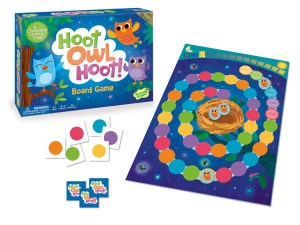
Because players choose both their bird and their card to use on their turn, the game presents some rudimentary strategy decisions for the young players to grow into. Players can even plan ahead by discussing the cards they each have, making optimal plays based on each others’ hands. There are also different levels of play, where the players can increase the number of owls that need to make it back to the nest for a harder challenge. For very young children, you can further simplify the rules into essentially Candy Land, for kids still learning colors and how to follow rules and directions, which people have told me Candy Land helps with.
My only nag for this game comes from the timer mechanic. When a player has a sun card in their hand, they have to play it and advance the sun token closer to morning, the point at which the game ends and the players lose. When we played, this consisted of the player’s entire turn, which sucks when you draw two or three of them in a row, which happened; so I would modify it next time so that the player gets to draw a replacement card and take their turn after playing the sun card. The sun card is also a little confusing to a small child, who usually associated the sun with good things. It was difficult explaining to my niece why I didn’t celebrate with her when we drew a sun card.
Busy Town, Big Board
We also played a Richard Scarry Busytown game. The game board was huge. Maybe five feet long, in four pieces, but not without reason. Most of the game involves moving the pieces along a forking path with the occasional shortcut using a spinner, but there are also Goldbug spaces on the spinner that trigger a mini-game where all the players look for as many pictures of a certain item on the game board as they can, like hot dogs or hammers or propellers. The size of the game board directly affects the experience, and the larger game board was a smart design choice.
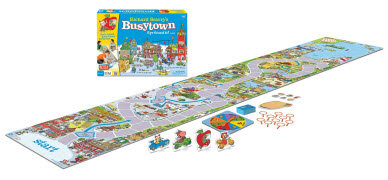
Another couple of spaces on the spinner say “Pigs Eat, Spin Again.” This is the timer mechanic; the players need to all get to the picnic island together before the pigs eat all of the picnic food. No player can even say that they got to the island before the other players, because the last brief stretch is by ferry, which doesn’t leave until everyone is aboard. So if one player doesn’t make it to the island, then no one does. Kudos on that design choice to encourage non-competitive gaming for young children, and for allowing players to spin again when they get the Pigs space.
Because we played on the ground, my niece did have trouble avoiding stepping on the game board as we played…
Pancake Race
In the most-played game (beside the perennial I’m Gonna Catch You!), which my mother- and father-in-law gave to the niece in question this morning, players compete in teams to build pancake stacks. The mechanics are very simple: you flip a card at the start of the game that shows the order the pancakes need to be stacked (e.g. chocolate chip, strawberry, plain, blueberry, banana), then the teams race to build their stack before the other team. The challenge comes from the distance between the griddle, where players must get their pancakes one at a time, and the plates, where they have to build their stacks. The rules dictate 15 feet for the distance. They also have to carry their pancakes on a spatula, much like an egg race on a spoon. You definitely have to (re)move furniture to accommodate this game of you play it indoors.
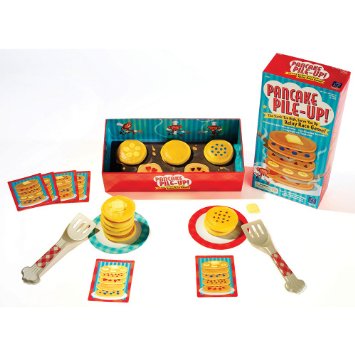
Playing this game with a three-year-old, we played a simplified version with loose enforcement of the “use a spatula” rule, and since it was only me and the kid playing, we obviously left out the relay team part. We also went for about three or four feet to the plate, except when I needed to occupy the kid for longer, when I had her play a solo game with the griddle and plates in different rooms altogether. This is definitely a fairly pure game of skill, and the game advertises itself for its development of a child’s “gross motor skills,” a term that I heard for the first time (and twice) today. It’s also easy to modify the rules and/or add handicaps, so it can be introduced early with looser rules and have some longevity with stricter adherence to the rules and any other twists you can think up. And what fun I can imagine at a kids party with actual teams!
Sesame Street Matching
We also played a Sesame Street matching game. Everyone knows these games, so there’s not much to explain here. My niece kept trying to tell me to pick what I knew was a wrong card, but I never could figure out whether she actually thought that’s where the right card was, if she was just pretending she knew where the right card was, or if she was actually trying to trick me into picking the wrong card. My best guess is the second option.
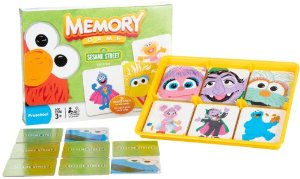
I would argue, contrary to my friend Alex’s opinion, that memory games like this are still skill-based games. I think there should be room in “skill” for non-physical abilities, and memorization can be strengthened and actively trained through practice. (Check out Moonwalking with Einstein if you don’t believe me. It’s a great read.)
A Comment on Flavor to Conclude
I don’t normally consider flavor text much when I play games (with D&D being a major exception here), but from this kid’s eyes it may as well all be flavor text, or don’t bother playing at all. Suns are exciting no matter what they mean for your chance of success. Picking which mechanically indistinguishable food the pigs eat matters deeply. Consideration went into which character cards went into the matching game each round. The flavor of the pancake matters much more than how long it takes you to get the pancakes on the plate.
It’s fun every now and then to see the the world of games through a child’s eyes.
 No Free Parking Money
Busytown! I had a computer game about Busytown when I was little. Good memories.
This next comment is sincere: any game with a 5′-long board is good in my book.
I hereby declare a schism in the world of game domains. Me and my pentachotomists will go play in this corner, and you and your qutrachotomists can play Sesame Street Matching with Joshua Foer.