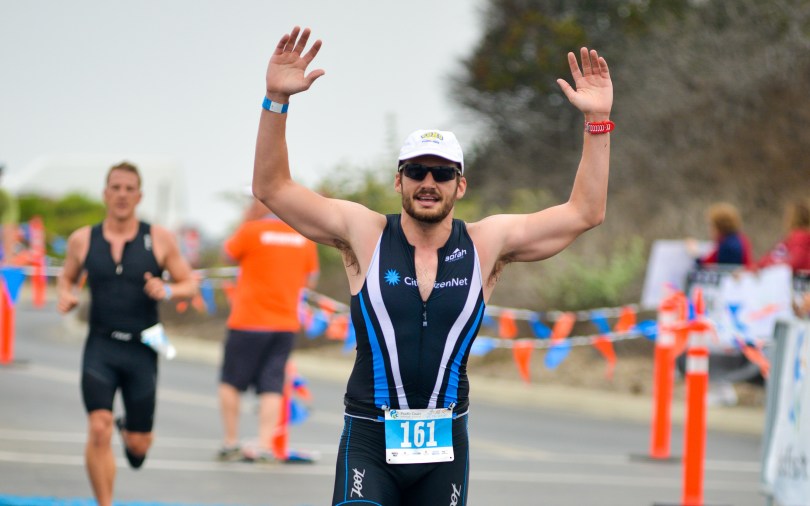
Today’s post will be a little different, because the “game” in question may not actually qualify as a game to most people, but is still nevertheless a competition: the 2016 Pacific Coast Triathlon, which I completed on Sunday morning.
General Thoughts


This was the fifth triathlon I’ve completed, and the first time I’ve done this event. It was a sprint triathlon, which usually is defined as 750 meters of swimming, 20 kilometers of biking, and 5 kilometers of running, but this race, as with every triathlon I’ve done to date, did not have exactly the distances they claimed.
The results are posted here; search for bib 161. My gun time was 1:19:36, which I’m happy with, though I didn’t have any actual goals set for myself this time around. I’ll get into the specifics of the results later. I had my Garmin Forerunner 920XT watch recording my race, which had a slightly different time because I goofed, but is still useful for confirming the distances and at least some of the times.
For what it’s worth: I placed 5th of 48 in my division (30-34 Male), 51st of 260 for men, and 56th of 368 overall. (And 1st of 4 in CitizenNet.) I haven’t checked how this compares to my rankings in past races, which might be a better comparison than times, since all the courses vary.
The most notable element of this race was the hills. I joke that there were hills even in the swim, which isn’t entirely hyperbole. I didn’t know there would be so many hills going into the race, because I hadn’t looked up the course beforehand. They weren’t murderous, but they weren’t negligible.
Swim (12:25) & T1 (3:41)
The swim was an ocean swim at a shorebreak beach with waves that could exceed 5 foot faces that morning. It wasn’t dangerous if you knew how to dive under and through waves, but it wigged me out just a little bit that there might be people who don’t know how to handle this, particularly while racing and trying to navigate a pack of other swimmers.
According to my watch (uploaded to Strava), the swim distance was about 800 meters. It could be that my watch’s measurements were a little off (plausible since it can only get satellite reception when my hand is out of the water); it could be that I didn’t swim the most efficient line; it could be that the buoys drifted a little; it could be a combination of these things.
Based on the distance my watch measured, and removing the time I spent running from the shore to the timing mat, I held about 1:30 per 100 meters. That’s a little slower than the pace I hold doing laps in the pool, but not by much, so that’s respectable.
I joke that there were hills in the swim not just because of the shorebreak waves, but also because there was an actual hill from the beach up to the transition area, and it wasn’t trivial. According to my data on Strava, the elevation change was about 80 feet. Whatever the grade was, it was rough.
One could argue that this run from the swim to the transition area balances out a bit the shortage in the run, but to me it doesn’t count, and is just a bonus obstacle.
My transitions are never very impressive, but my T1 time of 3:41 isn’t quite as bad as it would seem, because it includes that hill run, which also made it harder to move quickly once I got to my bike as I caught my breath.
Bike (38:59)
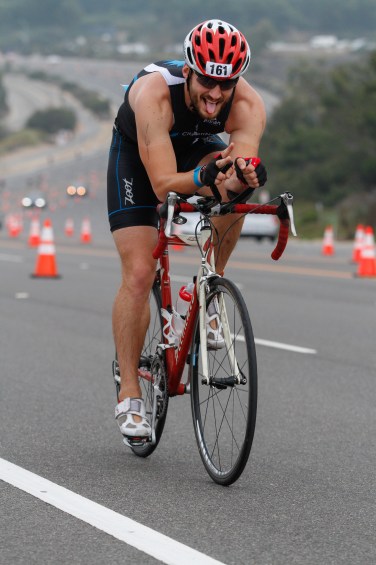 The ride was pretty true to the distance advertised, at only slightly more than 20 kilometers logged on my watch. Based on that, I held about 19.4 miles per hour. Normally that would be a little disappointing, since I usually cruise above 20 miles per hour, but with all the hills on this ride, I’m okay with this.
The total climb on the ride was 673 feet (205 meters). That’s not terrible, especially over 20 kilometers, but I don’t think there were any flats throughout the whole race, and it’s definitely the hilliest triathlon bike leg I’ve ever done. Strava says one of the hills had about a 5% grade for about a third of a mile. These climbs highlighted the gains I’ve seen in my hill climbing in the last few years, because I was usually passing people going uphill.
Coming down the hills, I topped my speed out at 36 miles per hour. I should have pushed harder going down the hills to accelerate until I was spinning out, but I think I was trying to recover after the climbs. If the climbs were a time for me to show off my quad strength, the downhills reminded me that I am not as aerodynamic as I could be on my bike, because the guys with tri bikes and aero helmets were passing me down almost every hill. Not much to be done about that without spending money (a lot of it), so I’m not going to worry.
By the way, if you’ve never heard a tri bike whiz by you, they sound like some kind of spaceship.
T2 (2:19)
I really have no excuse for this slow time, and I can’t account for what took me so long. The pros are in and out well under a minute, and while I’m not trying to be a professional here, it bears examining what takes me so much longer. I should be able to shave maybe a minute off my time.
My only gripe at this point in the race was that, leading into the transition area, there were signs saying “no passing,” pretty prominently and repeatedly. And I was riding slowly because there were volunteers and not a lot of room. Yet some guy was still impatient enough to pass me in tight quarters—I think maybe even on my right, which is a big faux pas—which bugged me, maybe more than it should.
Run (22:10)
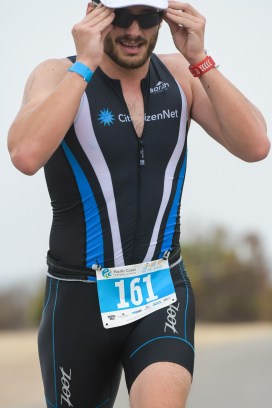 Running. The worst of the worst. My boss fight of any triathlon adventure.
I hate running, and in my first triathlon in November 2014 I got wicked sideaches and walked for a lot of the running leg. I don’t get sideaches anymore, but running is still by far the most excruciating part of the triathlon, and the part that I struggle to train for the most, mostly because I sometimes get shin splints and because I hate how excessively sweaty I get when I do it.
I set a goal to hold an 8:00 mile for the run, using my watch to monitor my speed. So when I first saw my time of 22:10, I thought, “Damn, I didn’t think I ran that fast. My watch usually said right around 8:00/mile when I checked it. Maybe I was running pretty fast when I wasn’t looking at my watch.”
Nope. Turns out, according to my watch, the run was a little shy of 4.5 kilometers. This irks me, because that’s a difference of more than ten percent, which is not negligible, and there were no buoys on this run. This is the reason that, if you want to measure progress in your triathlons, you really need to do the same event the next year, because even when you take out the hills, not all sprint triathlons are equal.
There were two particularly challenging parts to this run. First, there was about half a mile of running on sand along the beach, most of which I did on the wet sand close to the water. I run in Vibram Five Finger shoes, so when my feet got a little wet at one point, it didn’t bother me.
 Immediately following the beach run, there was a hill, which Strava says was about 90 feet of elevation gain at a grade over 10%. It hurt. I managed to keep “running” the entire time up the hill, with my pace bottoming out at about 11:42/mile for a brief moment before pushing myself back up to about 11:00/mile by the time I reached the top of the hill.
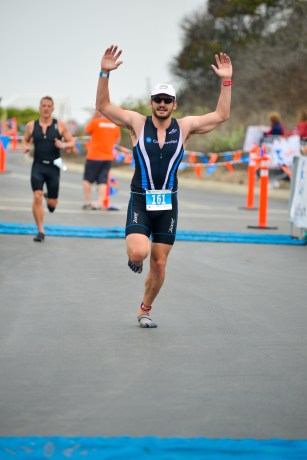
In the last bit of the run, after the hill, a guy who had been just behind me for the beach run passed me. I checked the age written on his calf, and it said he was in my age group. So, naturally, I sprinted for the last fifth of a mile or so, going from my reasonable 8:00/mile to a top speed of 5:15/mile. You can see that guy not far behind me in my finishing picture.
Final Thoughts
This was my first time completing a race with friends. (Last year I did the same event with my friend Zack, but he did the sprint and I did the olympic.) It was also my first time with any team gear, which made it really fun when I saw my friends wearing the same jersey as mine out on the course. That alone made this event worthwhile.
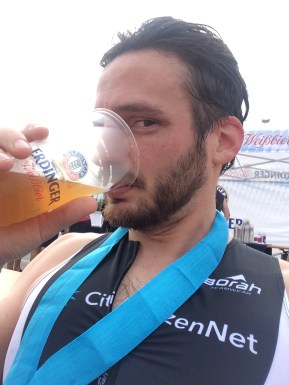
I wasn’t hoping to post an incredible time on this race, in part because I have another race coming up on Saturday, the Malibu Triathlon. (Or, as it is officially called, “The Nautica Malibu Triathlon presented by Equinox,” because I get emails from them pretty much weekly, and that’s both the name of the sender and the beginning of the subject line.) I also was more focused on enjoying the experience with friends, and I wasn’t in a very competitive or goal-oriented mindset in the weeks leading up to the event.
At the Malibu Triathlon this coming weekend, I’ll be doing the “International” distance (which is an olympic distance); I have another olympic triathlon, the Trick or Tri, in October (the same one I did with Zack last year); and I’ll conclude my season in November with the Turkey Triathlon, just a bit longer than a sprint, which I’ll be doing for the third year in a row.
I’ve managed to convince my big brother and some friends to do the Turkey Triathlon with me this year. Since I’ve done that race before, I have high hopes for posting a new record, and about two months to train to make that happen. Wish me luck!
 No Free Parking Money
You’re quire the Renaissance Man, Mr. Gibbs. I enjoyed your thoughtful (and somwhat statistical) post on an otherwise athletic activity. Kudos to you for being a good sport during the race, despite at least one other not taking as much care.
What is your ideal recovery time between triathlons? You have quite a few coming up here.
I wouldn’t normally do two weekends back to back, but I kinda wrote up this one as a practice for the Saturday race, since the Saturday race is so much longer. But for that one too I’m not so concerned about my time, both since I’ve never done that event before and because I’m doing it largely because it’s in Malibu.
Normally I space them out about a month or so apart, which gives me time to recover, train some more, and taper before the next event.